Archaeologists Visit the Historic Gridley Cemetery

An important first step in understanding one of Canton’s oldest and least-known historic places took place this week at the Gridley Cemetery, (1764) where an archaeological team from the University of Massachusetts Boston conducted a preliminary assessment of the site. This work is being conducted under the direction of the Canton Historical Commission through a Community Preservation Grant.
On Friday, August 28, John M. Steinberg, Ph.D., Research Scientist with the Fiske Center for Archaeological Research at the University of Massachusetts Boston, accompanied by a graduate student, spent approximately an hour at the cemetery conducting a preliminary walk-through and testing the use of Ground Penetrating Radar, commonly known as GPR.
The purpose of the visit was straightforward but important: could GPR successfully help us understand what remains beneath the surface of the Gridley Cemetery? The early indications are encouraging.
Dr. Steinberg conducted a limited GPR scan to evaluate ground conditions and determine whether the technology is likely to produce useful archaeological information at the site. Based on this preliminary work, we are pleased to report that the prospects for a successful investigation appear quite strong.
If plans proceed as anticipated, we hope a comprehensive archaeological and GPR survey can be undertaken in October 2026.
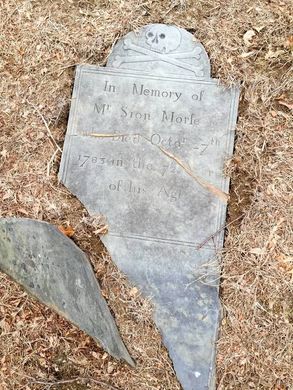
The Gridley Cemetery occupies approximately 2,304 square feet and represents an important surviving piece of Canton’s colonial landscape. Yet much about the cemetery has been lost to time. The locations of individual graves are largely unknown, gravestones may have disappeared or become buried, and the original organization of the burial ground is no longer readily apparent to someone visiting the property today.
A comprehensive GPR investigation could begin to change that. Ground Penetrating Radar allows archaeologists to examine variations beneath the ground without excavation. For a historic cemetery, where respect for the people buried there and protection of the site are paramount, this non-invasive technology offers an especially valuable way to better understand the landscape.
The proposed investigation will seek to locate and map possible graves, estimate the number of burials within the cemetery, identify potential buried gravestones or other features, and provide a clearer understanding of how the cemetery was originally organized.
One particularly intriguing question involves Colonel Richard Gridley, the celebrated military engineer associated with the Battle of Bunker Hill and the first Chief Engineer of the Continental Army. Gridley was originally buried here before his remains were later removed to Canton Corner Cemetery. Archaeological evidence may help us better understand the location of his original burial site, although identifying a specific grave with certainty will prove difficult.
The investigation is also an essential part of the larger Gridley Cemetery Preservation Project.
Plans for the property include the installation of historically appropriate fencing and interpretive signage. Before undertaking those improvements, however, we need to know what lies beneath the ground. Fence posts and sign foundations must be located so that they do not inadvertently disturb graves or other archaeological resources. That is why the archaeological work comes first.
The information gathered through the survey will help create a preservation plan grounded in evidence rather than assumption. It will allow future improvements to respect both the historic landscape and the people whose final resting place this became centuries ago.
The project is being advanced as a historic preservation initiative utilizing Community Preservation Act funding, with the goal of protecting the site, documenting its archaeological resources, and ultimately making its history more understandable and accessible to the public.
Friday’s visit lasted only about an hour, but it represented something much larger: the beginning of an effort to scientifically document a place whose history has been hidden beneath the landscape for generations.
There is still considerable work ahead, and GPR does not magically provide names for every grave or answer every historical question. Archaeology is rarely that cooperative. What it can provide is evidence: patterns, anomalies, possible burial shafts, buried features, and a much clearer picture of how people used this small piece of land centuries ago.
If the full investigation takes place this October, we may soon have our first detailed archaeological picture of the Gridley Cemetery and a far better understanding of how to preserve it for generations to come.





 RSS Feed