Open by appointment.
Canton Historical Society
  • Home
  • Research
  • About
    • Visit
    • Online Store
    • Membership
    • Support
  • News

Where's The Fire?

8/5/2025

0 Comments

 
PictureThe Hunneman in 1947.
We are so pleased to report on the progress of the conservation and preservation of one Canton's hottest artifacts - the Hunneman Hand Tub - one of Canton's first fire engines.  This early piece of fire apparatus was built for Ponkapoag in 1829 and features copper from the Revere & Son Rolling Mill.

The subject of the project is an artifact that was built expressly for the town and delivered into service on August 26, 1829. Having survived over 196 years, the artifact is undergoing conservation and preservation in the hands of a seasoned and highly professional conservator in Pennsylvania who specializes in materials such as wood, metals and leather. It is critical to note that this is a preservation project as opposed to a “restoration” project. The goal is to stabilize and conserve this item so that it can be interpreted and enjoyed by the public for decades to come.

The project features a new wooden cradle under the original pump, removal of varnish with a specially formulated solvent, and the casting of a few parts that had been lost over the years. The project will be done by the end of September. Upon completion, the Hunneman will be on permanent loan to the Paul Revere Heritage - Museum of Discovery and Innovation. Attached are progress photos. Please note that this project is funded by the Community Preservation Act. 

Historical Record
The first recorded instance of a fire engine being located in the town of Canton, Massachusetts is a record from 1825.  Early records from the Hunneman Fire Engine Company of Roxbury, Massachusetts show that a fire engine was constructed and delivered to the Massapoag Woolen Mill, Canton, MA. At the time, the only known woolen mill was the Boston Manufacturing Company (The Stone Factory) located at the intersection of what is today Walpole and Neponset Streets. Number 104 – Massapoag Woolen Mill was delivered on February 19, 1825.
 
The first record found in Annual Town Meeting minutes referring to fire equipment was on April 6, 1829 under an article "to see if the town will vote to purchase one or more engines and to adopt any measures relative thereto." It was voted to appoint a committee of seven to inquire into the expenses of such an action and its desirability. The Committee reported in May that engines would cost $250 each; hose would be 62 1/2 cents per foot and couplings $2.50 per joint. They recommended forming three companies of twenty one "efficient" men each, the majority of whom would be exempt from militia service, that each company be permitted to purchase an engine, and that the Town Treasurer pay each company $200 for the engine. Any cost over the $200 would be contributed by the engine company itself.
 
Two engines were bought, one for Ponkapoag, and one, the Enterprise, for South Canton. In 1833 a third engine was purchased for the Canton Center station. At that time Canton Center was considered to be the area later known as Canton Corner, which was from Eliot street to Randolph Street. South Canton was then what we call today Canton Center and was also known then as "The Village."

Following the spring Town Meeting, the Hunneman company records show that two engines were received by the town on August 26, 1829. The two engines were delivered by ox cart and were numbered No. 132 (Ponkapoag No. 2) and No. 133 (Enterprise No. 3). Records show that the town paid $365.00 cash for No. 132 and $410.00 for No. 133. The overage may be attributed to the hoses and extras that were included with each of the machines.

Over the subsequent years from 1825 through 1891 the No. 132 was in use and moved between Ponkapoag and the fire station located at Canton Corner. In 1891, the Fire Engineers Report stated that there were still two hand engines, one at Ponkapoag and one at Canton Corner. The fire chief described them “things of the past and not worth scrap value.” The machine that we seek to conserve may have been stored in the basement of Memorial Hall sometime before February 1901. By 1907-1908 the town’s inventory of fire apparatus no longer indicates any hand-tubs at any of the town’s engine houses. The Canton Historical Society opened its headquarters building in 1911 and it is likely the Society took possession of the hand tub at that time.

While perhaps as many as five Hunneman fire engines were delivered to the Town of Canton over the years, the only surviving piece of equipment is No. 132. It is an earlier example and closely related to the hand tub that was used at the Revere Copper & Rolling Mill and the Kinsley Iron Works.
​
Historical Association
William C. Hunneman was “an enterprising apprentice of Paul Revere.” Paul Revere operated his original foundry in Boston and Hunneman learned the trade of metallurgy and innovation under the eye of the master, Revere. In 1790 Hunneman founded his own business to furnish the necessary hardware to support the leading industries of the day, shipbuilding and clock making. Soon he started to make fire engines, and from 1792 to 1883, the company that bore his name furnished firefighting machines around the globe.

The name “hand tub” or “engine” derives its origin from the fact that the body is, actually, a tub design to hold water. Formed from sheets of copper, turned out by the Canton works of Paul Revere sheathe the bottom of ships, the fire engine was an oblong wooden box, lined with sheets of copper to seal in the water, and a pump was installed to force the water through hoses. The pressure of the hand tub could force water up to 125 feet and was used mainly to contain the spread of fire from neighboring buildings in the event of a fire

Owing to the historical connection to Paul Revere through the apprenticeship and the extreme likelihood that the foundry in Canton provided the copper for the hand tub, this project has a close affinity to the new Museum of Discovery and Innovation at the Paul Revere Heritage Site. The fire engine is a remarkable artifact that shows how the ingenuity, enterprise and scale of manufacturing touched and enabled several industries and the entrepreneurial spirit. The Canton Historical Society is a proud steward of this great artifact. 

0 Comments

Tours Set for Paul Revere Heritage Site

10/1/2016

1 Comment

 
Picture
The stage is set!  Join two Canton historians (George Comeau and James Roache) on a public tour of this heritage redevelopment site. Centrally located in the town, the Paul Revere Heritage Site is a 40-acre allotment along the Neponset River. The former industrial site is currently being adapted for contemporary reuse, and shall build townhouses, condos, apartments, a dog park, trails, and a park with historic features. The future 9-acre park contains the historic Revere & Son copper-rolling mill and the Joseph Warren Revere Barn. The complex was founded by Paul Revere and proved to be the birthplace of the nation’s copper industry. Current redevelopment concepts being explored call for the mill to be used as a heritage museum and cultural center, and the barn to be transformed into a destination restaurant.

Tours are limited to 20 spaces at a time, and advance space must be reserved (free.)
Saturday, October 8th at 9:00 am and 10:00 am
Sunday, October 16th at 1:00 pm, 2:00 pm, and 3:00pm
Wear comfortable shoes, this is a walking tour. 


Reserve your advance tickets (free) by clicking this link. 

Note James Roache will be available on October 16th only.

1 Comment

Field Trip

10/11/2015

1 Comment


Quarterly Meeting Features Trip to PRH Site

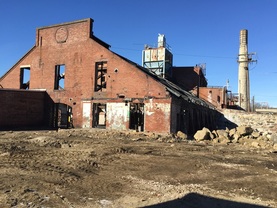
The day was bright, the colors vivid, and wonderful company gathered at the Paul Revere Heritage Site to get a private "behind the scenes" tour of the Paul Revere Heritage Site at the former Plymouth Rubber factory complex. The members only tour was arranged by George Comeau, a member of the Paul Revere Heritage Advisory Commission. "We spent about an hour and a half touring the site and getting an up-close view of the ongoing adaptive reuse of the Joseph Warren Revere Barn and the Copper Rolling Mill," said Comeau. Also conducting the tour was James Roache a curator at the Histy with a deep knowledge of the site. Jeremy Comeau was on hand to help visitors a better understanding of the development agreement, timing for the project, and potential uses.

​More than twenty members attended the tour which was complete with cider and donuts. A perfect autumn day that brought members back to 1801 when Paul Revere came to Canton to begin the copper industry in America. The Canton Historical Society will be an important partner in the ongoing efforts to transform this hazardous site into a 9 acre park, cultural and historical attraction and one America's most historic sites tied to post-colonial industry. 

Take a look at the tour and some of the buildings in their present state. 

​
1 Comment

    The Histy

    An occasional compendium of news and happenings at the Histy and historic preservation in Canton.

    Archives

    August 2025
    June 2025
    January 2025
    April 2024
    February 2024
    November 2023
    June 2023
    March 2022
    August 2018
    July 2018
    June 2018
    May 2018
    April 2018
    October 2016
    September 2016
    May 2016
    April 2016
    October 2015
    September 2015
    August 2014

    Categories

    All
    Community Preservation Act
    Exhibits
    Fundraising
    Historic Preservation
    Paul Revere Heritage
    Special Events
    Volunteers

    RSS Feed

      Join Our Mailing List

    Subscribe to Newsletter

Location

Contact Us
1400 Washington Street
Canton, MA 02021
​781-615-9040

Become a member today. 

Copyright 2025- Canton Historical Society, Inc.  Canton, Massachusetts